Einstein Awards in Córdoba: recognition for Miguel Sofo Haro, a researcher at the CNEA
November 3, 2026
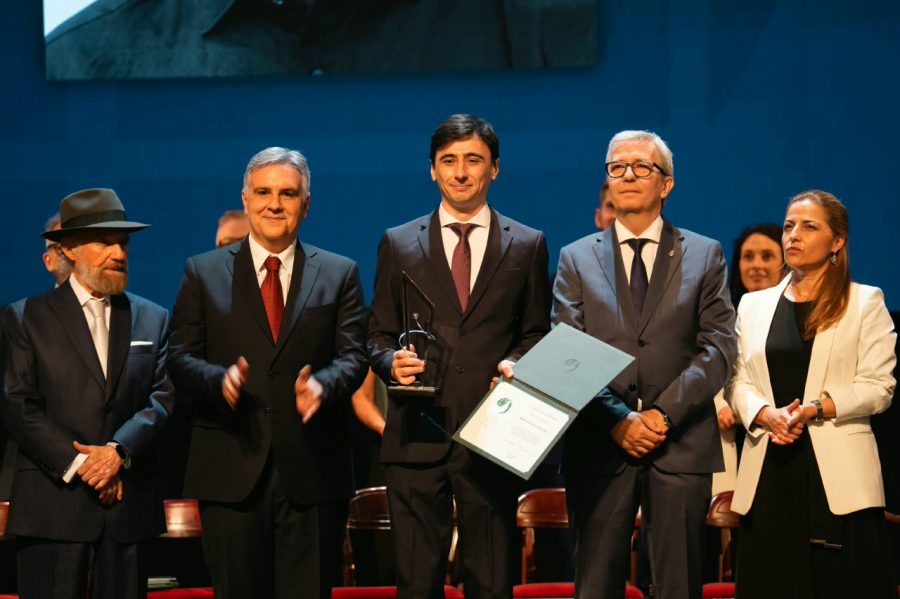
On November 2, the National University of Córdoba (UNC) hosted the 41st ceremony for the Albert Einstein World Award of Science, presented by the World Cultural Council (WCC). Among the 12 scientists, researchers, and students from Córdoba selected to receive this recognition was Miguel Sofo Haro—an electronic engineer (UNC graduate), researcher at CONICET and the National Atomic Energy Commission (CNEA), and a member of the Management of Technology and Research in Universe Sciences / Institute of Technologies for Detection and Astroparticles (GTICU/ITeDA).
A bridge between engineering and frontier physics
The career path of Miguel Sofo Haro demonstrates how applied engineering can intersect with fields such as high-energy physics, astroparticle physics, and related areas—disciplines that seek to answer fundamental questions about the universe. After graduating with a degree in Electronic Engineering in Córdoba and completing his undergraduate thesis at the RA-0 nuclear reactor, he went on to earn a PhD in Engineering Sciences from the Balseiro Institute. For over a decade, he was a member of the Particles and Fields Group laboratory at the Bariloche Atomic Center (CAB), where he contributed to projects that bridge the gap between scientific research and technological development.
Along this journey, he participated in the design of electronics for projects in collaboration with ITeDA, as well as in experimental developments such as ASCII—a detector built using plastic scintillator material for the Pierre Auger Observatory.
The Skipper CCD sensor and the best limits in the search for dark matter
One of the milestones in his career occurred during his doctoral studies. At the Laboratory for Particles and Fields, Sofo Haro—along with other researchers—spearheaded the development of a particle detector based on charge-coupled devices (CCDs) for the ANDES underground laboratory. Later, thanks to a fellowship, he spent a year at Fermilab in the United States, working with a research group focused on applying “Skipper CCD” technology to the detection of dark matter. It was there that he captured the first image using this sensor—a small, highly sensitive silicon device.
After just one week of data collection, the team established the most stringent limits to date in the search for light dark matter. Specifically, these results helped narrow down the possible masses of these particles, as well as the likelihood of their interaction with ordinary matter.
Today, he remains a member of the scientific collaborations that continue to refine this technology; indeed, the work stemming from this development ranks among the most highly cited of his scientific contributions.
Furthermore, these advancements earned him recognition from the scientific community: in 2017, he received an award at a U.S.-based conference for doctoral students, and in 2023, he was honored with an award for young researchers from the National Academy of Exact, Physical, and Natural Sciences (ANCEFN). In 2018, he also received an honorable mention in the biennial experimental physics thesis competition organized by the Argentine Physical Association.
This line of research involving specialized detectors has extended to other locations, such as the Sierra Grande mine in Río Negro, where he and the ITeDA institute conducted experiments aimed at searching for dark matter using high-sensitivity detectors. Additionally, in collaboration with colleagues from the University of Buenos Aires (UBA), Sofo Haro is studying the interaction between neutrinos and atomic nuclei, using a Skipper-CCD installed at the Atucha nuclear power plant. For Sofo Haro, his primary motivation remains the experimental work that these projects provide: “measuring, observing what happens, and taking on the challenge of making something new work.”