Discover Space Launches a Call for Papers on Cryogenic Detector Technology
November 04, 2026
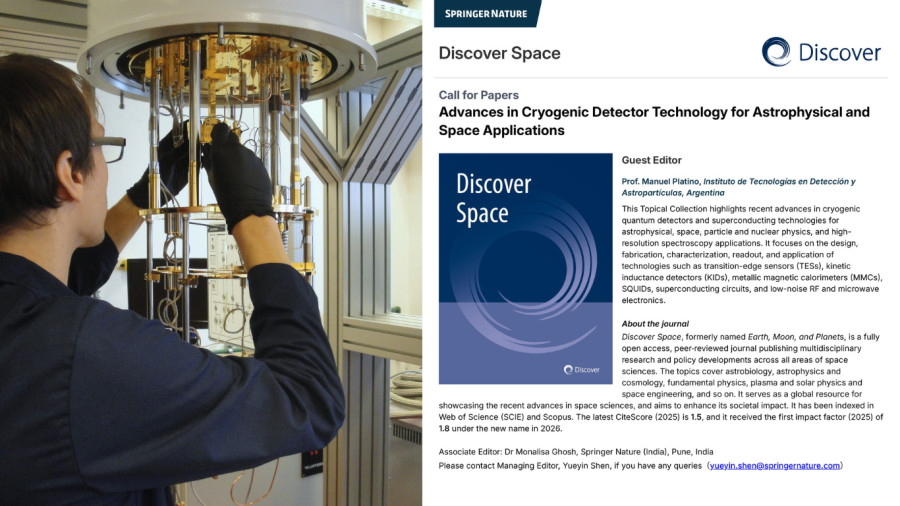
The purpose of this collection is to bring together research communities in astrophysics, particle and nuclear physics and spectroscopy that use cryogenic quantum detectors and related superconducting devices for astrophysical and space applications.
On this occasion, ITeDA researcher and Vice Director Manuel Platino has been invited to serve as an editor of the collection. The articles will focus on the design, fabrication, characterization, readout, and application of these devices in the aforementioned fields of research.
Submission deadline: July 1, 2027.
Cryogenic detectors are widely used in astrophysics, cosmology, and fundamental physics. Their exceptional sensitivity makes them suitable for applications ranging from dark matter and neutrino detection to the observation and characterization of the cosmic microwave background (CMB), the relic radiation from the early Universe. Beyond these fields, cryogenic detectors are also used in high-resolution X-ray and gamma-ray spectroscopy.
The development of cryogenic detector systems relies on a broad range of technologies, including superconducting electronics, radio-frequency and microwave electronics, and advanced microfabrication techniques. Prominent examples of cryogenic detectors include metallic magnetic calorimeters (MMCs), transition-edge sensors (TESs), and kinetic inductance detectors (KIDs). MMCs and TESs are commonly read out using superconducting quantum interference devices (SQUIDs), either through direct low-frequency readout or multiplexed architectures based on RF and microwave techniques. KIDs, in contrast, are intrinsically superconducting microwave resonators and can be naturally multiplexed and read out using RF electronics.
Many of the technologies developed for cryogenic detector systems, including superconducting circuits, Josephson devices, SQUIDs, microwave resonators, low-noise RF electronics, and microfabrication, are central to the development of extremely low noise detectors for space applications. This technological overlap provides a natural connection between traditionally distinct research communities.
More information: https://link.springer.com/collections/hicgcbbjac